
PROGRAM TRAINING
(Session 2)
What are they?
If the term durable skills is unclear to your students, here is a brief definition we will use throughout the program.
Durable skills are the traits, qualities, mindsets, abilities, and attitudes that enable success in the workplace and in life.
Context:
Through pilot testing, teachers identified lack of time as a major constraint—especially for a subject that requires transformation rather than memorization. To address this, we refined our approach and now use a microlearning, metacognitive framework.
How To Use MindSage Lessons
Simple. Consistent. Thought-Provoking.
One lesson: Three Short Sessions
Ideally, you’ll want to:
Start a new durable skill lesson each Monday, if possible.
Each durable skills lesson is divided into three sessions—traditionally labeled Monday, Wednesday, and Friday or labeled Session 1, Session 2, and Session 3. Ideally, all three sessions should be completed within one week.
You do not need to follow those exact days, but we recommend allowing time between sessions and focusing on only one session per day. The introduction should be covered with the whole class. This includes the primer questions and the lesson video.
The goal is to cover the introduction, primer questions, and lesson video together as a class, at minimum.
Unfinished material can be reviewed independently. Students decide whether to complete the remaining session materials. If you have a daily durable skills period, the rest of a content can be spread over multiple days.
The more content the class or team can cover together, the better.
Explaining the Power of Micro-Learning
Explain the power of microlearning—brief, consistent messaging that helps students recognize how it works in their daily lives and how it will support their progress in the program.
You can show this video, or teach the concept using your own example that demonstrates the power of microlearning.
Using the Lessons
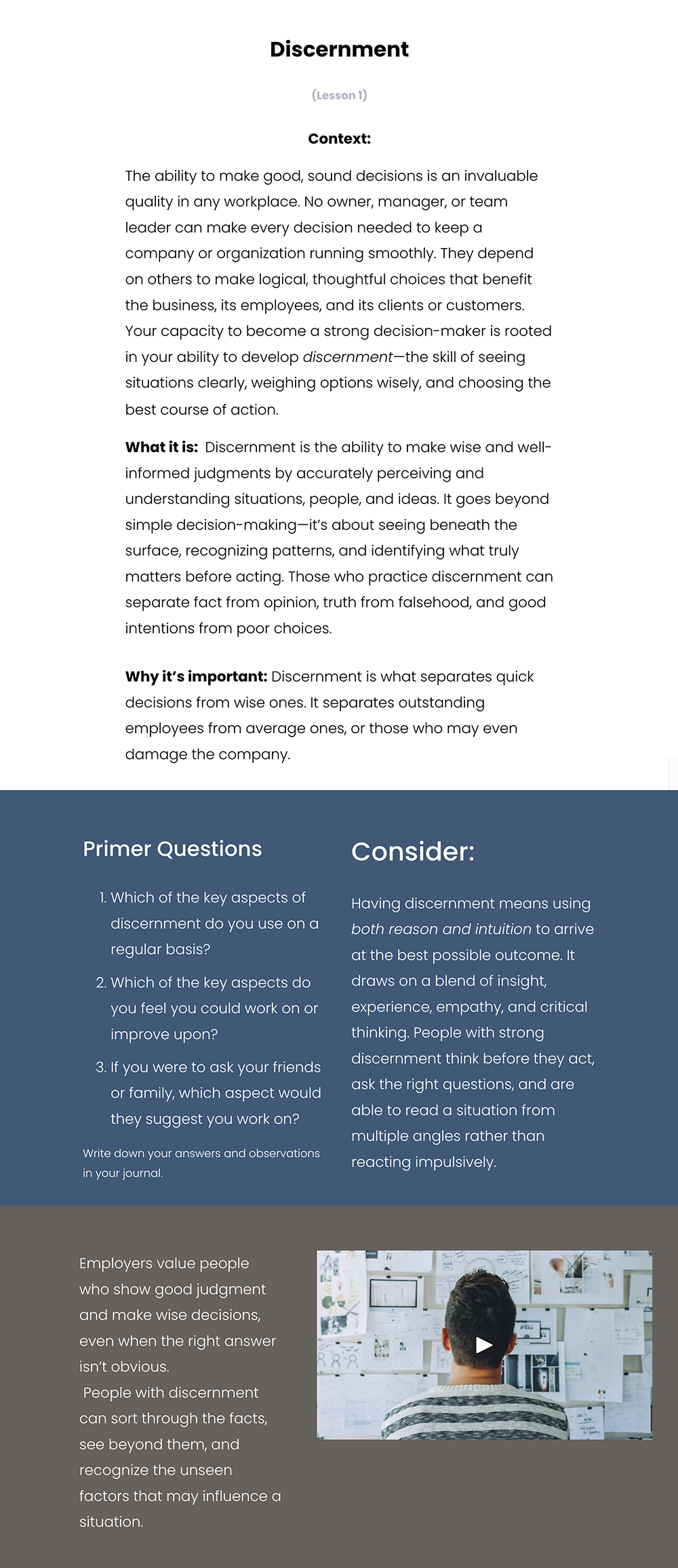
Each section contains only a small amount of information—by design.
The real transformative power comes from taking the time to help students think deeply about what they read and discuss.
Introduction: Have one or more students read the Context, What it is, and Why it’s important paragraphs. Then ask if what they read makes sense or if they have any initial comments.
Primer Questions: Read and discuss as many primer questions as time allows.
When asking primer questions, reiterate that you are more interested in students’ opinions than in whether an answer is right or wrong.
Lesson Video: The lesson video should be viewed as a class whenever possible. Depending on how many primer questions you address, reading the introduction paragraphs, asking a few questions, and watching the video can typically be completed in 15–20 minutes. If you have longer class periods, you can discuss the material in more depth or move on to additional sections.

04 — Framing the Culture and Environment
You are not just a class, you are a team.
So that means:
Teams may receive only goals and objectives, not step-by-step directions. Figuring out how to proceed is part of the learning process.
Emphasize/value Growth, not grades (change in thinking, attitude, and behavior)
Highlight the value of self-awareness and self-development (investment), not just coverage of material
Use these reminders from time to time:
“The durable skills you’re learning about are what employers want and are looking for.”
“This material isn’t academic. You can’t cram for a test. Can’t fake it. Employers will know.”
“Step out of the typical school mindset. In this program, you are encouraged to think independently and share your opinions. Always be respectful of others when doing so.”
“Businesses spend billions teaching their employees. You’ll have an edge if you enter the workplace with these habits, traits, qualities, and attitudes.”

Additional framing
We also want students to understand how this program differs from their regular classes and curriculum:
When we ask questions, we want your thoughts and opinions. It doesn’t matter if your answer is “right” or “wrong.” Don’t be afraid to raise your hand and share your ideas, feedback, and opinions. You’ll need this skill in the workplace, and this is great practice.
We may not always give specific directions. Instead, we often provide goals or objectives, giving you the freedom to find your own solutions. This mirrors what will be expected of you in the workplace.
We may not always give specific directions. Instead, we provide goals or objectives, giving you the freedom to find your own solutions. This mirrors what will be expected of you in the workplace.
Do not view your classmates as competitors. Instead, see them as team players working with you to accomplish a common goal.
This program gives you a chance to be creative and use your imagination. These skills are highly valued by employers, as they help you develop solutions and become an innovator.
Summary
In our eight-week program, we usually begin with Refactoring lessons. These lessons help students recognize habits developed in traditional school settings that may unintentionally work against the durable skills needed to perform at a high level in the workplace.
However, since these lessons are not currently available in our public lesson library, we recommend starting with the foundational lessons: Self-Awareness, Self-Acceptance, and Self-Appreciation.
Before beginning, we want you to understand how to use the online lessons.